
Showing posts with label PADDLING. Show all posts
Showing posts with label PADDLING. Show all posts
Monday, October 24, 2011
A Hydric Hammock
 This photo was made yesterday in the Lower Suwannee National Wildlife Refuge, as a group of us were about to paddle Sanders Creek from the Dixie Mainline bridge to the Gulf of Mexico. It shows what I am calling a hydric hammock. The uplands on both sides of Sanders Creek consist of swamp, with baldcypresses and hardwoods. Slightly lower in elevation, the creek bottoms support marsh punctuated by cabbage palms. The water in the creek is tidal and brackish. At this point, about four miles from the Gulf, smooth cordgrass, black needlerush, and sawgrass are found in close proximity. Respectively the three species are characteristic of salt marsh, brackish marsh, and fresh marsh, and they are separated here by slight differences in elevation. Blue crabs were abundant in the clear water of the creek.
Saturday, July 16, 2011
Black Mangroves in Bloom


Our neighbor and mosquito expert Dan Kline alerted us to this year's unusual flowering of black mangroves at Cedar Key. He mentioned that these and some other flowers attract mosquitoes.We have also learned that mangroves are attractive to bees and were formerly important to the honey-producing business. We took the above photos in late June.
Although the abundance of flowering here in 2011 was unusual, we know that black mangroves have flowered at Cedar Key in other recent years. We took the photo below in October of 2008 of a tree covered with "seeds"--actually the trees are considered live-bearers, because the seeds have already germinated when their capsules fall into the water.

Sunday, May 8, 2011
A Shell Mound Paddle
 |
| Hog Island seen from the Shell Mound boat launch. |
 |
| After a rough passage, the lee side of Hog Island seemed serene |
Friday, April 29, 2011
Who We Met Today
Walking nearly 12 miles in San Felasco Hammock today, we had some fun experiences with wildlife, only a portion of which we were able to capture in photographs. Enjoy with us the ones we photographed and are able to share.
Thanks for joining us on our little tour of the very slow or stationary plants and wildlife encountered on our walk. Unfortunately the numerous lizards, butterflies, and birds we observed were too quick for us to capture their images.
 | |
| Good Guy #1. We found him on his back and unable to right himself, perhaps flipped by wild pigs planning to make a meal of him. Once rescued and again upright, he beat a beeline for his burrow. |
 | ||||
| Bad Guy #1. This is poison oak. What more needs to be said? |
 | |||
| Good Guy #2. This little alligator is all right with us, at least until he grows up and decides we don't belong in his territory. |
 | ||||
| Good Guy # 3 Honest, this really is another gopher tortoise, our second of the day. |
 | ||
| Good Guy #4 Just when you were getting convinced that all gopher tortoises look alike, we present you with this juvenile, not only smaller, but more colorful than his elders. |
 | ||||
| Bad Guy #2 This little plant, often bearing pretty white flowers, is called "Tread Softly." If that doesn't tell you enough, consider its other name, "Stinging Nettles." |
Thursday, April 21, 2011
Shired Creek Paddle

Thursday, March 31, 2011
Natural Landscapes?
 |
| A Roadside Ditch |
 |
| Shell Mound |
Activities of both the Paleoindians and much more recent lumbermen have apparently served to increase habitat diversity, and thus are probably favorable for wildlife. Nevertheless, one is led to wonder how different the area might have looked 12,000 years ago.
Except for occasional prehistoric shell mounds along the immediate coastline, paddlers will likely see landscapes much less affected by anthropogenic change than hikers.
Wednesday, March 23, 2011
Pickerelweed
 |
| Pickerelweed (Pontederia cordata) |
Here's another common wetland plant of freshwater habitats of the Lower Suwannee National Wildlife Refuge. Not quite a local specialty, we enjoy it also when we visit the Adirondacks in August. There it is common in the "Newton Falls pond" reach of the Oswegatchie River and likely also in the nearby Chaumont Swamp.
We might marvel that this plant thrives as well 1,200 miles north in New York State's Adirondacks as it does in Florida, but in fact its geographic range is even broader, extending from Nova Scotia to Argentina. Surely pickerelweed is another of Nature's winners.
They're Back!

It is always a thrill to see these remarkable birds for the first time in the season, and almost as thrilling to see them the second, third, fourth, etc. times.

Spadderdock and Arrowhead
 |
| Stadderdock |
 |
| Arrowhead, in a Clump of Sawgrass |
Sunday, March 13, 2011
Fringe Tree

Tuesday, March 8, 2011
American Snowbell


We saw this small flowering tree yesterday while walking with a group on the Lower Suwannee National Wildlife Refuge's River Trail. The plant was abundant and flowering profusely on relatively dry sites along the swamp trail as it proceeds from the trailhead toward the Suwannee River. Checking our field guides, we soon were able to identify it as American Snowbell (Styrax americanus).
An informal group of volunteers within the Friends of the Lower Suwannee and Cedar Keys National Wildlife Refuges recently placed signs along the trail identifying many of the diverse kinds of trees there. The list is growing as additional species are identified and markers placed. American Snowbell will surely be a future addition.
The exercise of placing signs of educational value to hikers leads to questions about the kinds of information that should be provided to best add value to the experiences along the paddling trails. Placing signs along them would be impractical and perhaps undesirable. Figuratively and literally, paddlers seem more likely to be seeing the forest than the trees. Conveying the sense of the forest (or marsh) with both scientific and aesthetic integrity will be a considerable but not unwelcome challenge.
Saturday, February 19, 2011
On the Suwannee
 |
| Turtles Soaking Up the February Sun |
 |
| Weeks Creek, Off the Suwannee |
Thursday, February 10, 2011
Lower Suwannee Waterfowl, Part 2
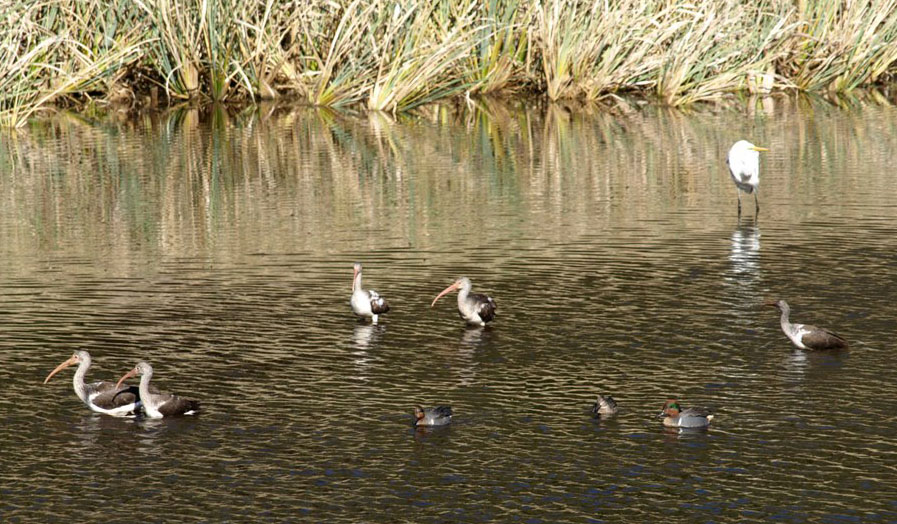 |
| White Ibises, Green-winged Teal, Great Egret |
Fortunately, Tom Liebert has been kind enough to send along some additional photos. Lacking a long lens he was unable to get close-up images, but nevertheless I am reasonably confident I can identify three waterfowl species. They are green-winged teal (Anas crecca), bufflehead (Bucephala albeola), and lesser scaup (Aythya affinis). The scaup are no surprise as we have often spotted them in brackish water near Cedar Key. Additional species may have been present, but the images do not permit positive identification.
It may be next year before we again get the fantastic panorama of wildlife, including hundreds of ibises, that we saw on the pond last December. It is certain, however, that in the future we will be keeping our eyes out for them.
Forests of the Lower Suwannee River Basin
 |
| USGS Map Showing Distinct Forest Patches Near the Mouth of the Suwannee River (the town of Suwannee with its canals is shown by the greenish patch at the upper left) |
This body of work can serve as an essential aid to anyone seeking to understand the physical environment and its role in the biology of the lower Suwannee. Far too detailed for the paddling guide, results of these studies will nevertheless help us to frame our presentation in ways that will convey the diversity and complexity of the system.
Tuesday, February 1, 2011
Sand Pine

Interestingly, its strategy for dealing with fire differs radically from that of the more highly regarded longleaf pine. Longleaf seedlings and adults are highly resistant to fire, trees are durable, and they reproduce slowly. In contrast, sand pine seedlings and adults are quite vulnerable to fire, and they make up for this and other handicaps by maturing quickly and producing large numbers of fire-adapted cones.
Wednesday, January 26, 2011
Lower Suwannee Waterfowl, Part 1
Years ago, when boning up for my new job as Staff Specialist for Migratory Bird Research in the Fish and Wildlife Service, I quickly learned that Florida is not a hotspot for wintering ducks, geese, or swans.
Now that we live in north Florida, we occasionally see wood ducks and mottled ducks, both year-round residents. The only snowbirds we have routinely noted are small rafts of lesser scaup, seen near Cedar Key, and frequent and abundant hooded mergansers on freshwater ponds around Gainesville.

An exception was our sighting on a freshwater pond on the Lower Suwannee NWR of what in the distance appeared to be pintails. They stayed far enough away to make identification difficult. One did come close enough for us to take a fuzzy photo, which appeared to confirm the identification. Still other photos kindly provided by Tom Liebert revealed at least two additional species. I will post information about them later, when identifications have been confirmed. Meanwhile, I hope that others will add their observations.
 |
| Freshwaer pond on the refuge; zoom in to see what we believe is a pintail |
A glance at the FWS graphics below offers clues why Florida is not more important for wintering waterfowl. The species breeding abundantly in the Prairie Pothole region--the continent's "duck factory"--winter in the lower Mississippi region. Lesser numbers breed in the northeast, and most winter along the mid-Atlantic coast.
 |
| Mississippi Flyway |
 |
| Atlantic Flyway |
Friday, January 21, 2011
More on Longleaf Pine
 |
| Reproductive Stages of Longleaf |
One bit of good news: they aren’t completely absent from the areas where I had failed to notice them earlier. Searching more intently, I spotted a few along State Highway 24 between Bronson and Cedar Key. Indeed, they were not infrequent in the Cedar Key Scrub State Preserve, sharing a scattered overstory with sand and slash pines. They even appeared to be reproducing in a few locations. They were rare in the Devil’s Hammock, an area obviously intensively managed for slash pines. This area is quite wet, as is much of the land between Otter Creek and Rosewood, and slash pines might dominate wet sites even in the absence of management.
Information gleaned from the book led to some insights concerning otherwise suitable places where longleaf pines are rare or absent. These pines take many decades to reach maturity and once cut over, there is little incentive for commercial foresters to replant them or encourage their regrowth. Loblolly and slash pines, on the other hand, grow much more rapidly and can be harvested after only a few decades. And pines grown for pulpwood are best for paper production if harvested at 20 years or less. The economic advantages of quick rotation have caused commercial forest management to favor these fast-growing species to the exclusion of longleaf, and many public forests have also been managed for maximum timber harvests. It should be of little surprise that the longer and more intensively an area has been managed, the less likely one is to find longleaf. Conversely, occasional specimens are often encountered on suitable lands that were never subjected to intensive forest management.
Monday, January 17, 2011
Longleaf Pine
 |
| Longleaf Pine (San Felasco State Preserve) |
I am less than 20% through the book, but already find it both revealing and challenging. I am hoping that before reading too much farther I will get a better sense of the local distribution of longleaf pine and understand why it apparently does not now occur on the Lower Suwannee National Wildlife Refuge. Is past management at fault, or are more basic constraints at work? The species is regarded as the keystone of a unique and once widespread ecosystem, and losses over its once expansive distribution are decried by conservation biologists. Efforts are underway to reintroduce it on the Lower Suwannee Refuge, and any insights gained about strategies for restoration might prove useful.
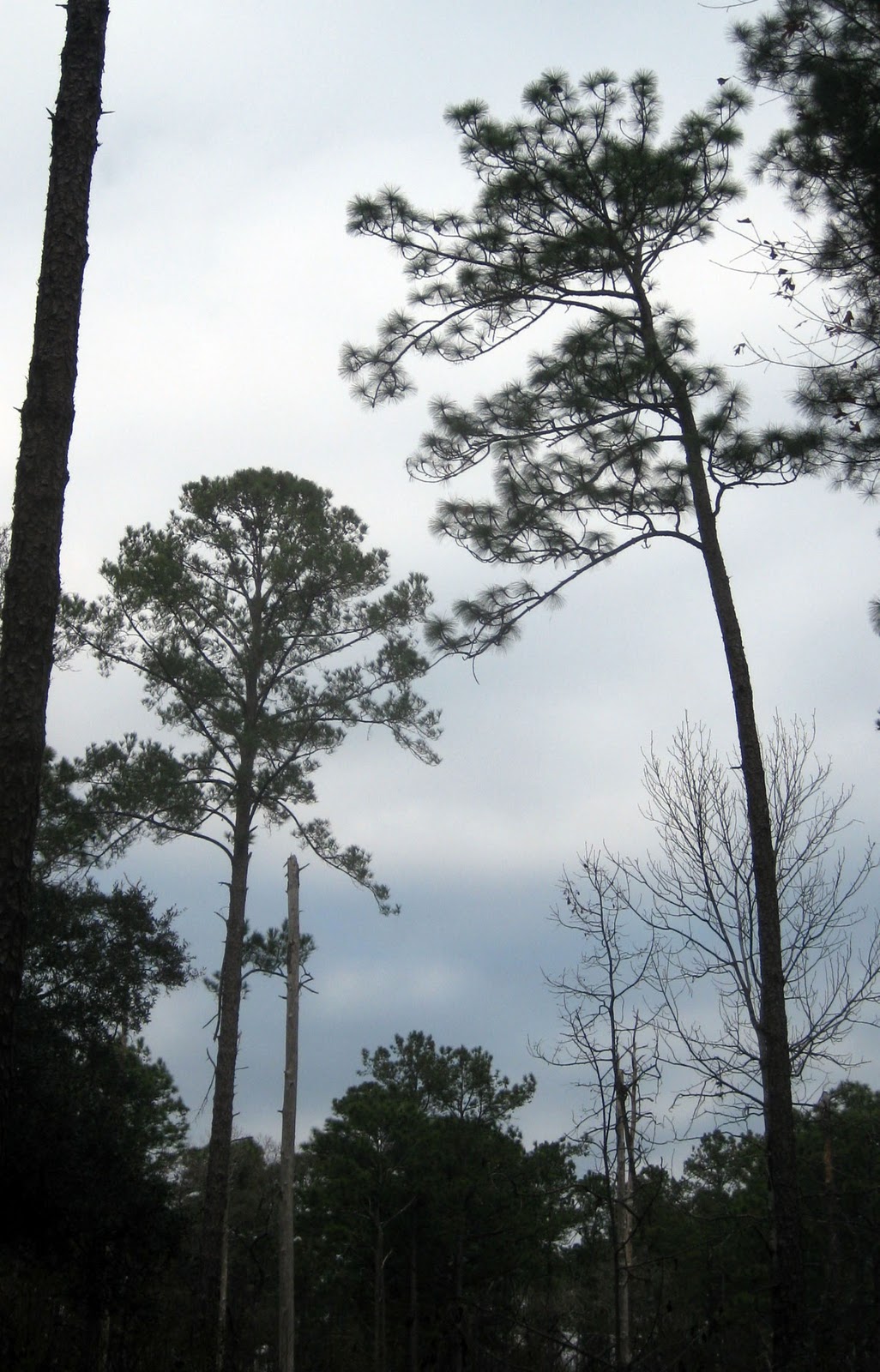 |
| San Felasco longleaf (r) and loblolly (l) |
We are puzzled by the apparent absence of longleaf pines on the refuge and wondering whether they were ever a dominant species there. Stay tuned. Reading Easley's book is like following a mystery story, wondering what clues may appear to reveal where the story is going. Follow us as the mystery unfolds.
Monday, January 10, 2011
Why Buttressed Trunks on Wetland Trees?
OK, no comments on the blog, but here is one answer that nature offered to me while I was conducting a study many years ago (in 1995, in fact). I was doing a followup survey of a population of box turtles that had been marked 50 years earlier. The questions were: how many turtles were still alive five decades later, and what was the current status of the population? The site was a floodplain forest of Maryland's Patuxent River in the current Patuxent National Wildlife Refuge.

But there are no (or at least very few) beavers in Florida, you might say. I would counter that fossil beavers were common here, perhaps 20,000 years ago. But really, beavers are unnecessary, and the trees are probably older than beavers anyway. Picture the damage that might occur to the lower bark of trees in swamps during raging floods that carried tree trunks and other heavy debris downstream. Like the Maryland beavers, the flood-borne materials could surely abrade bark from tree trunks, threatening their survival. However, with buttressed trees, the exposed buttresses of flooded trees might be abraded, but the bark in the concave surfaces between buttresses would be relatively safe. So protected, the trees could live to endure many more floods.
P.S. Re: the box turtle study. A few turtles first marked in 1945 remained in 1995. And the population, although apparently devastated by severe flooding caused by Hurricane Agnes in 1973, appeared to be on the road to recovery. Regrettably, although we published our results, no subsequent publications have documented the later status of the population.
Thursday, January 6, 2011
Why do trunks of wetland trees often have buttressed bases? Looking for Ideas...
 |
| Scene from the Lower Suwannee NWR - click to enlarge |
The photo above, made in the floodplain forest of the lower Suwannee River National Wildlife Refuge, shows the trunks of what appear to be at least three kinds of trees. The one in the mid-distance at the center left is clearly a bald cypress (Taxodium distichum). I would need to return to the site to know for sure, but suspect the one only partially shown in the near left is a water tupelo (Nyssa aquatica) and the leaning one in the right foreground is a water hickory (Carya aquatica). What they have in common and with several other kinds of wetland trees is the way the fluted bases of their trunks differ from the mostly circular bases of their upland relatives. Even when the same species may thrive in both wet and dry sites, they may have trunks with mostly round bases in the dry sites and extensive buttressing in wet sites.
Swollen trunks in wetland trees are believed to develop when flooding causes hormones and nutrients to accumulate near the water line, promoting more rapid growth in that part of the trunk. The fascinating question is not how buttresses are formed, but why they are formed. Nature is rarely wasteful, and unless the energy invested in buttresses produces some advantages for their trees, they likely would disappear.
Any ideas about the significance of these formations--what they do for the trees? I have one, but am interested in what others may think about the value of buttressed trunks. I'll reveal mine in a later post.
Subscribe to:
Posts (Atom)