Showing posts with label ADIRONDACKS. Show all posts

Wednesday, January 28, 2015

Fee-fi-fo-fum: Chiggers in the Adirondacks

I remember as a child sometime back in the early 1950s coming back from an outing at Lake Bonaparte covered with mysterious bites. I was miserable, and my mother and the neighbors had no idea what had afflicted me. The best they could come up with was "it must be sand-fleas."

Flash ahead to 1962, and I'm in graduate school in Kansas. I've been hired by my major professor to help him by catching glass lizards, a species he has been studying. I'm a miserable failure because at the end of the day my body is covered with welts. I couldn't sleep for the itching. Poison ivy, I guessed, but when I went to the campus medical center, they immediately diagnosed my problem as aggravated chigger bites.

Flash ahead again to 2006, and we're staying in Wanakena. I spent several hours walking along the "back" road from the Oswegatchie River bridge toward the junction of County Route 61, photographing wildflowers and butterflies along the roadside. Later I was covered with chigger bites and, having encountered the critters throughout the midwest and south, I had no doubts what they were. 

I recalled my late father-in-law telling me there indeed are chiggers in the Adirondacks, but until my own experience, I had remained skeptical.

Adirondack chiggers may be less hungry or, more likely restricted to a brief limited feeding cycle in the northern part of their range, but I've become a believer.

Interestingly, only "yankees" seem to be susceptible to chiggers. Maybe having lived in the south for so long, I've developed a sort of immunity. 

Any other experiences with chiggers in the North Country?


Saturday, June 23, 2012

Florida Maple

Florida Maple is one of our more interesting plants here in the north central part of the state. Some botanists consider it a subspecies or variety of the sugar maple (Acer saccharum...variety floridanum), while others consider it a separate species (Acer barbatum or Acer floridanum, the two names only adding to the confusion).


Whether or not it is truly distinct from the sugar maple, the two appear to be very close relatives.

A reminder: sugar maple is the source of that stylized red leaf adorning the national flag of Canada. 


So what are trees so dominating much of Canada that they are considered the symbol of the nation doing in Florida? One thing they are doing differently here is generally growing in the understory, rather than as the dominant tree in the upper canopy, as in much of the north. We've seen fairly large specimens in San Felasco Hammock State Preserve, but never so tall that they over-top other species.


One possible answer may lie in their ecological specialization. The one thing these trees do better than almost any other is tolerate shade. For this they pay a price, because nearly all the adaptations for tolerating shade tend to make trees poorer at conserving water. In the north (in the Adirondacks and much of northeastern and north central U.S., as well as in Canada) where it is cool and moist they can use their shade tolerance, enabling them to shade out competitors and dominate the forest canopy. Here in the Florida peninsula, however, they require the shade, humidity, and soil moisture retention of rich woods where other tree species help them avoid excessive moisture loss.


Any other suggested answers will be welcome.


Saturday, January 7, 2012

Wanakena

Packbasket Adventures Lodge in Wanakena, NY
Yesterday we received an e-mail message from Rick and Angie Kovacs announcing that they are about to lose the Packbasket Lodge in Wanakena to foreclosure. We've stayed there, enjoyed their hospitality, and we hope some way will be found for it to keep operating. Perhaps someone with deep pockets will keep it going for the sake of the community.

The failure of the enterprise raises questions about the future of Wanakena as a resort destination. Surely the public agencies that helped get start-up funding envisioned the lodge as the core of a revitalized community. However, one lodging doesn't a vacation community make, and to our knowledge there has been no movement toward developing other visitor-friendly amenities, let alone lodging options.

The evolution of Wanakena has taken it first from a company town developed for logging, to a resort enjoying a brief heyday, to a bedroom community providing needed housing for the nearby iron mine and paper mill, to a quiet backwater. Perhaps its best and highest future is to remain a quiet backwater.

Monday, October 24, 2011

Making a Living in the Adirondacks

Lisa Bramen has an interesting article in the December 2011 issue of Adirondack Life magazine. Titled "Live Here, Work Here," it explores the employment options for someone who wants to live in the Adirondacks. The options (find one of the rare jobs, telecommute, start a business, commute to a nearby population center) remind me of a section on options for economic development in the Clifton-Fine community I explored in Gem of the Adirondacks.

The telecommute option I proposed in 2005 was unrealistic because the region had very poor electronic communications. Fortunately this is now being remedied by a new fiberoptic link that should make high speed internet service possible. Also an additional cell phone tower is planned that will offer service to much of the area.

The same issue of Adirondack Life carried the bad news that of 14 post offices in the Adirondacks proposed for closure, four of them serve the hard-luck Clifton-Fine community. The post offices are Fine, Cranberry Lake, Newton Falls, and Wanakena. Presumably the post office in Star Lake would serve the entire community. As the article noted, having a post office is important not only for mail delivery, but is also important in promoting cohesion in small communities. 

Sunday, August 21, 2011

A Public Meeting


On August 8, 2011 the St. Lawrence County legislature conducted its normal monthly meeting in Star Lake, NY, in the 500 seat auditorium of the Clifton-Fine Central School. (The much diminished school now has only 350 K students in K-12, down from 1,300 at its peak enrollment.) The choice of location was intended to inform the local public about the current status of efforts to clean up and redevelop the J & L (Benson Mines) industrial site.

Unfortunately, trivial, routine, and unrelated business took up most of the allotted meeting time, and attendees were impatient by the time the main topic came up for discussion.

Mining activities were terminated 34 years ago, and the mine plant was partially dismantled. As a zoned "industrial site" within the highly restricted Adirondack Park, citizens have long hoped to attract some other business to the site. It is known to suffer from pollution from spilled petroleum and other contaminants, however, and any re-use is contingent on assessment of hazards and clean-up. 

In what turned out to be a setback, an environmental consulting firm hired to conduct needed assessments failed to provide the services for which it was contracted, and moreover stuck the county for over $400,000 in out-of-pocket expenses. One purpose of the meeting was to update citizens on the status of negotiations with the company for redress.

As was said more than once during the meeting, 34 years is a long time for a problem of this magnitude to persist. The fortunes of the community have deteriorated significantly during that period, and will continue to wane while the issue remains unresolved. Unfortunately, even needed assessments have not been conducted, and there are no good prospects for a quick fix.

Ruins of the mine plant, as seen from State Route 3 in 2002

Heath Pond


Located a few miles west of Wanakena, NY, Heath Pond is one of the headwaters of the Little River, a tributary of the Oswegatchie. Probably the stream feeding it was originally impounded by beavers, although today a logging road takes the place of the beaver dam. The beavers haven't given up, however, and from time to time they manage to block the culvert that carries the overflow.

Geologists believe that in the past the larger Oswegatchie flowed through the current channel of the Little River. More than 10,000 years ago glacial moraines blocked the old outlet of Cranberry Lake and forced the Oswegatchie into its current channel.

The photo above does not do justice to the beauty of the scene; it looks in a southerly direction, and the difficult lighting does not permit the camera to distinguish the subtle difference in coloration of red and black spruces and other vegetation features.

Saturday, August 20, 2011

Save our Schoolhouse and Athletic Prowess

For the past several years civic-minded members of the Star Lake, NY community have mounted a series of coordinated volunteer events to preserve the hamlet's 1882/1892 schoolhouse and turn it into an asset for the community.

The Star Lake School in 2011
One such effort is the annual Save our Schoolhouse 5k Run and Walk. Participating for the fourth year, we were among more than 100 runners and walkers.

Tension Mounts as the Race is About to Start

Called the Adirondack Exhibit Center, the old school serves as a gallery displaying the work of local artists, an orientation center to features of the community, and a gathering place for local events. Proceeds from the 6th Annual 5k Run and Walk will help fund installation of a new roof, the last major needed structural improvement. More information about the Save our Schoolhouse organization is available here.

This year three of us who were members of the 1961 graduating class were winners in the 60-69 year age group. 


The 1961 Class of Winners

50 years and counting - Smiles and Solemnity

I'm just back from Star Lake, NY, a small and easily overlooked place on the forgotten western fringe of the great Adirondack wilderness. On the fair night of June 26, 1961 forty-seven of us graduated from Clifton-Fine Central High School. Last week we celebrated the 50th anniversary of that event. Since our graduation, nine have gone on to their eternal rewards. The attachment to us survivors remains strong, however, and about 20 of us attended reunion events in Cranberry Lake or Star Lake.

We were the largest class ever produced by our community,  and we benefited from a time of great local prosperity and promise. The intervening years have not been kind to the community, but we can look back fondly on the best of those good times.

Thanks to classmate Gary Peterson for sharing this photo, made at one of the events.


Wednesday, March 30, 2011

Fifty Years Later

 Next June 26 will mark the fiftieth anniversary of my high school graduation. Exact counts vary, but that night approximately 47 of us were launched into the wider world from Clifton-Fine Central School in Star Lake, NY, on the all-but-forgotten western edge of the great Adirondack wilderness. The event will be celebrated in a social gathering the weekend of August 12-13.

Excitement has been growing since classmate John Phillips has climbed a steep learning curve and acquired a high level of skill in social media. In its brief existence, the facebook page he manages has garnered over 450 followers and done wonders to help reunite the Clifton-Fine Diaspora. It has not only brought together semi-centenarians like us, but has strengthened linkages across the generations.

Wednesday, March 23, 2011

Pickerelweed

Pickerelweed (Pontederia cordata)
Here's another common wetland plant of freshwater habitats of the Lower Suwannee National Wildlife Refuge. Not quite a local specialty, we enjoy it also when we visit the Adirondacks in August. There it is common in the "Newton Falls pond" reach of the Oswegatchie River and likely also in the nearby Chaumont Swamp.

We might marvel that this plant thrives as well 1,200 miles north in New York State's Adirondacks as it does in Florida, but in fact its geographic range is even broader, extending from Nova Scotia to Argentina. Surely pickerelweed is another of Nature's winners.

Wednesday, February 9, 2011

Lyon Mountain vs. Benson Mines

I just finished reading Lyon Mountain: The Tragedy of a Mining Town by Lawrence P. Gooley. Naively expecting the book to be similar in scope and content to my Gem of the Adirondacks, I was surprised, though certainly not disappointed. The two books are as different as are the communities and events they portray.

Although both Lyon Mountain and the Benson Mines had in common their Adirondack geography, geological history, and the quality and abundance of their iron ores, they had some important differences. Large scale mining at the Benson Mines did not get fully underway until after the Second World War, whereas industrial-strength mining at Lyon Mountain was well underway more than sixty years earlier. The open-pit mining practiced at the Benson Mines was almost certainly less hazardous than the deep mining at Lyon Mountain, and Benson's miners benefited in their time from improved sensitivity and regulations to promote safety. And while Star Lake and other communities surrounding the Benson Mines had certain characteristics of boom towns, labor was mostly recruited locally, and there was never the active recruitment of disembarking immigrants that characterized the staffing of Lyon Mountain. Nor did the ascendancy of the Benson Mines usher in an era of ethnic rivalries and lawlessness such as plagued Lyon Mountain.

In Gem of the Adirondacks I credited the leaders of the Benson Mines with technical foresight and well-intended attempts to win the allegiance of workers. No such credit attaches to the leaders at Lyon Mountain who, with rare exceptions, embraced a vision of industrial relations based on power and compulsion. Gooley cites the Lyon Mountain baseball teams as providing the kinds of outlet and community cohesion necessary to offset difficult and dangerous working conditions. Company supported leisure and educational activities promoted at the Benson Mines by the Jones and Laughlin Steel Corporation also were obvious attempts to improve the quality of life of employees, but their offerings were more numerous and more diffuse than the singular role of baseball in promoting civic life in the Lyon Mountain community.

Readers of Gem of the Adirondacks and Star Lake and those of us who experienced what now seem to have been the glory days of the Benson Mines should read Gooley’s book. The similarities and contrasts of the two Adirondack mining communities are important in understanding and coming to terms with our recent past.

Monday, January 3, 2011

Kudos to the Smallest Hospital in New York State

Clifton-Fine Hospital 2003
In Gem of the Adirondacks I wrote of the smallest hospital in New York State and my experiences there. Not quite out of my teens, I had taken many spills while water skiing on Star Lake with friends. Two days later I was admitted to our local Clifton-Fine Hospital with double pneumonia. I nearly died, but thanks to the people at the hospital my demise was postponed, so far by 48 mostly interesting years.

A few years ago we were again in Star Lake when one of us had an unexpected and disturbing vision problem. At the hospital's clinic we learned that there is no ophthalmologist on staff, but they could give us contact information for several in towns an hour or so away. That's fine, we said, but our cottage doesn't have a telephone (everyone knows that cell phones don't work there). No problem the receptionist said, and she promptly made the call herself and got us an appointment for us that very day.

New Construction and New Facade 2010
Visiting the community last year, we noticed construction underway on a significant new addition. And late in the year we received a solicitation for a donation to help pay for the new facilities. The new wing will support consulting and out-patient care. We gladly responded and we commend others to support the organization also. It is one of the community's most valuable assets.

Decades after the water skiing mishap, we now live in a community of perhaps a quarter of a million people with a major university and at least three very large hospitals. Indeed, health-care is the largest employer in Gainesville, Florida. Nevertheless, if I were to experience chest pains, for example, I would not know where best to go or what to do to receive the most timely and appropriate care. Like my neighbor with signs of suffering a stroke, would I find myself sitting for hours in a hospital emergency room? He had waited with dozens of other sufferers, next to an unfortunate and moaning youth who casting poorly, had lodged a fishing hook in his ear lobe.

People who have never been seriously ill or who are lucky enough not to have had any friend or family member needing health care have claimed that we in America have "the best health care system in the world." One wonders what planet they inhabit, but perhaps they are not as disconnected from reality as the mass of our citizens believe them to be. Instead they may have had the good fortune to live in a backwater place like Clifton-Fine, on the ragged and almost forgotten western edge of the great Adirondack wilderness. Maybe this tiny part of America's personal and non-industrial  approach to health care can really stake a claim to being the best. We don't know, but we want to help keep this slim glimmer of hope and promise alive.

Thursday, December 16, 2010

From the Adirondacks to the Developing World

A disturbing article on today's Reuters.com website told of the decline of manufacturing in the United States and the resulting loss of blue-collar jobs. It quoted a man in the booming business of selling used industrial equipment. In 2003 for the benefit of potential customers he began a newsletter announcing plant closures. His reports have averaged 150 plant closings per month, or more than 10,000 to date. Most equipment ends up in developing countries. He ruefully told the reporter that everything in manufacturing plants is recyclable except the workers.
 
The article got me thinking about the Benson Mines plant. In Gem of the Adirondacks I concluded that its machinery had probably been cut up and sold for scrap. I should have known better. I had seen, scanned a copy of, and even cited information from a brochure put out by the company auctioning off the equipment. Rather than being destroyed, it was likely sent off to Peru or some other distant destination where it was put to use. Despite the immediate harm done to our local community by the closing, I am cheered a bit to realize that everything in the unhappy event was not wanton waste; some of the human capital invested might have been saved. The plant shut down for good in 1977 and 33 years is a long time, but just maybe a few often-repaired parts of the old plant are still serving people somewhere.

Monday, December 13, 2010

The School Bus

Aerial View of Wanakena ca. 1950s or 60s
Another cold snap in north Florida brings my memory back to December 1955, on the roadside near the New York State Ranger School in Wanakena. We would be waiting for the 8:00 AM arrival of the bus that would take us to the Central School in Star Lake. The cold was miserable, but as I reported in Star Lake (available from Lighthall Books), the school bus was one of the happiest memories of those days. We got to know all the children in Wanakena within the first few days and weeks. Better yet, we sixth- and seventh-graders got to rub elbows with Juniors and Seniors and began to look forward to one day being as trendy and sophisticated as they were.

Thursday, November 18, 2010

You Can Leave, But You Can't Get Away

Postcard View of the Star Lake Inn in its Heyday
It is obvious from our books that we haven't gotten away from the Adirondacks. And just last week we were reminded again that we probably couldn't get away, even if we wanted to. 

 We were giving a presentation based on The Summer of a Thousand Cheeses at The Village community in Gainesville, Florida. As a way of introducing ourselves to the 40 or so in attendance, we showed the covers of our earlier books in one of our slides. It was a lively group, and we fielded many questions.

As people were filing out a man came up. He had noticed Star Lake in the title of one of the books, and wondered what the connection was. Hearing that I grew up there, he asked if the Star Lake Inn was still in existence. He explained that in the summer of 1943 as a 16-year old he worked as a bellhop in the Inn, then a large and popular resort hotel. The Inn has been gone for four decades, but old connections never seem to disappear completely. The huge and expanding world became  a bit smaller when we discovered that two of us, at least, have a mutual acquaintance.

Saturday, November 13, 2010

Newton Falls Challenged Again

After the optimistic and hopeful posts provided last week, I was shocked and concerned to see the news conveyed by this article in the Watertown Daily Times. Let's hope markets will improve, the niche market for Newton Falls Fine Paper products will improve, and the fine efforts of so many good people will bear abundant fruit.

Crunch Time for Adirondack Nonprofits?

An article "Gibson Starts New Group" in the September/October 2010 edition of Adirondack Explorer tells of the formation of Adirondack Wild, a new conservation organization founded by former employees of another conservation organization. The organization they left, Protect the Adirondacks, was formed in 2008 by the merger of two other organizations. Adirondack Wild was apparently too new to have launched a public membership and fundraising campaign, but Protect the Adirondacks had a full-page advertisement in that issue of the Explorer, as did the Adirondack Mountain Club, and the Adirondack Council. The Adirondack Chapter of the Nature Conservancy was apparently more frugal, having only a half-page advertisement. The Adirondack Explorer itself is a non-profit focused on Adirondack issues, and it also carried a full-page appeal for contributions.

With five Adirondack advocacy organizations with broadly overlapping missions appealing for support and a sixth likely soon to join them, we wonder whether the landscape is so crowded and the influence of individual organizations so diluted that few if any can be effective.

Wednesday, November 3, 2010

Newton Falls Revisited

Newton  Falls in 2003
Readers of Gem of the Adirondacks learned of the bleak fortunes of the little Adirondack community of Newton Falls. The hamlet was built around a paper mill, and the mill brought prosperity for nearly 100 years. But beginning in the eighties the mill went through a series of wrenching shutdowns, layoffs, and changes in ownership. Ultimately the mill, which once had employed 500, was shuttered. When my book went to press in 2005, the mill had been closed for five years, there was little hope it would ever reopen, the local economy was in shambles, and Newton Falls was beginning to look like a ghost town.
 
The story has taken a happier turn however, and it is one I could not have imagined following the former decline. In 2007 the mill reopened under visionary leadership, 100 jobs returned to the community, and the operation has since become a model for economically and environmentally sustainable paper making. This time the story is not mine to tell, and I encourage you to visit the Newton Falls Fine Paper website to read it in the words of the people who made this remarkable rebirth possible.

Monday, October 25, 2010

New Adirondack Birds

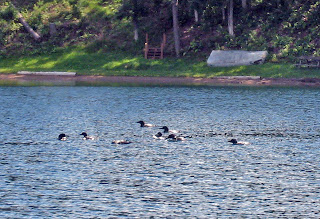
Eight Loons on Star Lake in 2010
Growing up in Star Lake 50 years ago, my friends and I considered ourselves natural woodsmen with inborn knowledge of the plants and wildlife around us. In fact, we knew little. We exemplified those people who know too little to grasp the depth of their ignorance. Our knowledge of birds was mostly restricted to the larger and more conspicuous kinds familiar to almost everyone.

With that disclaimer, let me report that in recent years we have seen species of birds in and around Star Lake that were unnoticed and probably not there (or very rare) in the fifties and sixties. Here are the ones recently noticed:

Common Loons. We were aware of the presence of loons in the Adirondacks, but never saw one on Star Lake. We spent a lot of time on the lake, mostly in speedy motorboats, and therein may lie a connection; the constant high-speed recreational boat traffic of the time may have kept them away.

Wild Turkey. We have read that the mast-poor Adirondacks formerly provided insufficient winter food for turkeys. Sometime in more recent decades they developed the practice of feeding on winter buds, and this appears to account for their presence and current abundance.

Canada Goose. Those we have seen are probably the giant Canada variety, or so-called nuisance geese—resident populations derived from released individuals. They have shown up in many parts of the country.

Turkey Vulture. We did not notice them in the past and suspect they were either absent or very rare visitors.

Double-crested Cormorant. The appearance of this bird should be no surprise. Populations were seriously depressed by DDT in the fifties, sixties, and seventies, but recovered quickly. Cormorants are now abundant, increasing, and often unwelcome almost everywhere.

 Is global warming involved? Perhaps, but as noted above, other explanations suffice in some instances.

Canada Geese on Star Lake, 2007